MJW Optics Lab Website & CMS
The problem
Prof. Wu's lab had two unmet needs. Publicly, the lab ran on a static site that doubled as the professor's academic presence — publications, and the popular-science writing he wanted to share with a general audience — but every update meant editing code and redeploying, so content drifted out of date and only whoever last touched the repo could change it.
Internally, shared instruments were booked on a paper sheet taped next to each machine: you had to physically walk over to reserve a slot, and log your usage by hand at the instrument when you were done.
The solution
I built one platform that serves both audiences, and the lab manages it themselves. For the public side, non-technical staff edit bilingual (EN/中文) content — publications, science articles, and lab info across 9+ content types — through a draft-and-review workflow, with no code and no redeploys.
For the lab side, an online booking system replaced the paper sheet: members reserve hourly slots from anywhere, check in automatically, and file their usage log and equipment-condition report through QR checkout instead of scribbling at the machine.
Because the site is fully bilingual, keeping two languages in sync would normally double the maintenance. I turned that into a highlight with one-click AI translation: admins maintain content in a single language and Gemini drafts the other, so everything is written only once. AI output is always a reviewable draft, never auto-published.
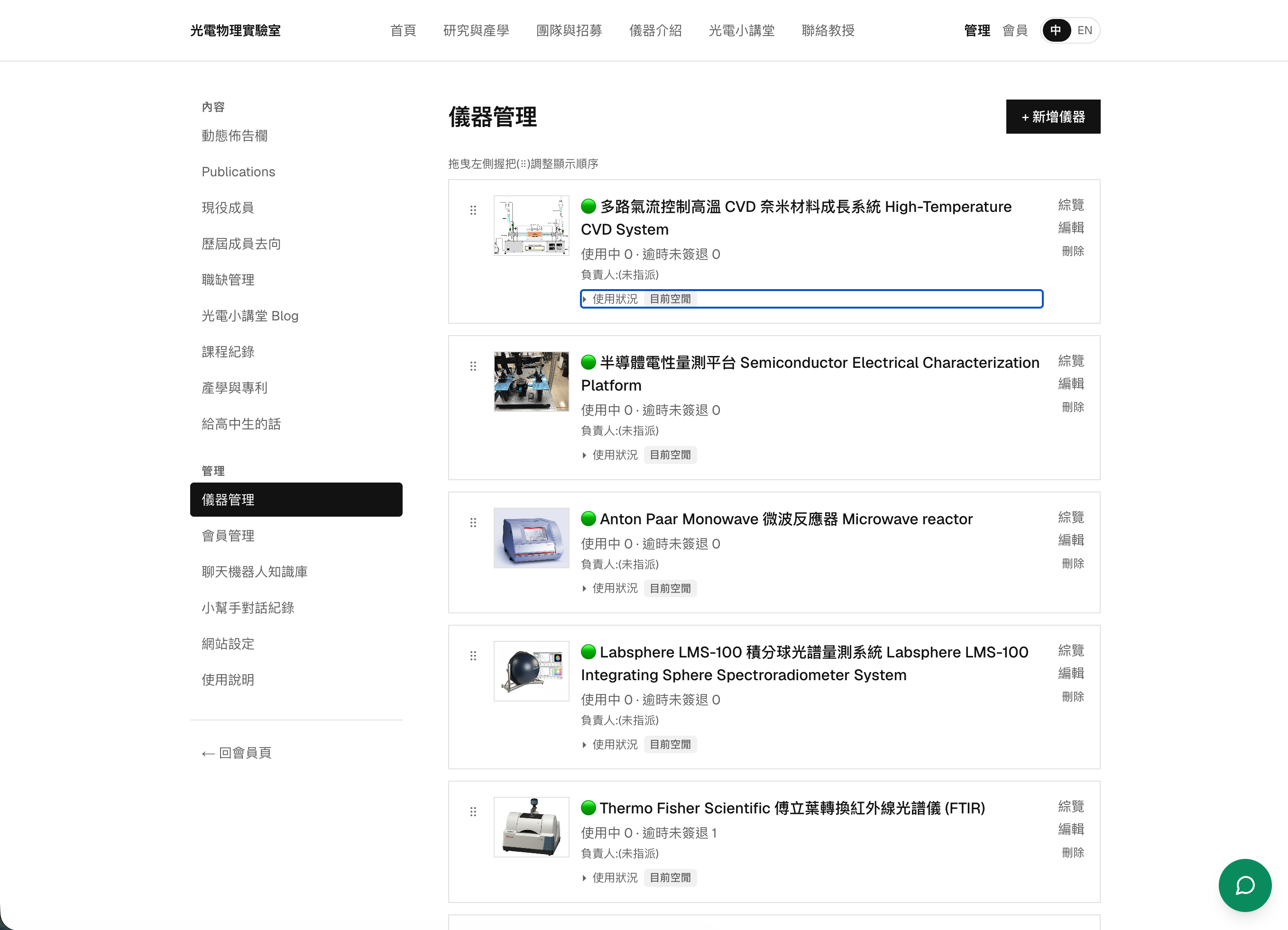
Instrument management — the admin catalog behind the booking system: drag to reorder, assign a per-instrument manager, and track live status (in use, overdue checkout, or free) that replaced the handwritten sheet.
Key features & challenges
- Authorization is 100% application-layer RBAC; RLS is used only to seal Supabase's auto-generated anonymous REST API.
- Three-tier roles (student / admin / super-admin) with instrument-level manager permissions.
- One-click AI translation — maintain one language, Gemini drafts the other.
- Online hourly-slot booking with auto check-in and QR checkout, replacing a paper sheet.
My contributions
- Sole developer, AI-assisted with Claude Code. I worked out the requirements with the professor, tested the features and checked the screens.
- Worked out the booking rules with the professor: hourly slots, auto check-in, QR checkout with a condition report, and a booking block after three late checkouts.
- Added AI features with Gemini: Word-to-draft, one-click translation, and a rate-limited bilingual FAQ chatbot.
- Shipped on Vercel + Supabase with GitHub Actions scheduling.